

The Blue and Yellow
Macaw (Ara ararauna) is a brilliant blue parrot with a yellow breast and belly and a white face and black collar.
These birds are about three feet tall. They are excellent climbers. In the wild they prefer a diet of fruit and nuts.
Macaws mate for life. The nest is built in the hollow of a tree. Two to four eggs are laid, then incubated for about 25 days. The young fledge in a little over three months and will remain with the parents for about one year.
Blue and Yellow Macaws are found in Mexico, Central and South America. They prefer rain forest habitats and spend much of their time in the upper canopy. They have a lifespan of about 80 years in captivity.

The Scarlet Macaw (Ara macao) is a large red parrot with blue and yellow colored wings, a white face and a beak that is light above and black below.
These birds are about three feet tall and weigh about three pounds. They are excellent climbers. In the wild they prefer a diet of fruit and nuts.
These birds mate for life. The nest is built in the hollow of a tree. Two to four eggs are laid, then incubated for about 25 days. The young fledge in a little over three months and will remain with the parents for about one year.
Scarlet Macaws are found in Mexico, Central and South America. They prefer rain forest habitats and spend much of their time in the upper canopy. They have a lifespan of about 75 years in captivity.

The Hyacinth Macaw (Anodorhynchus hyacinthinus) is a parrot native to central and eastern South America and is found in areas of Brazil, Bolivia and Paraguay. It prefers palm swamps, woodlands, and other semi-open wooded habitats. It is the largest of the macaws at 3.3 feet from the top of it
s head to the tip of its tail. It is easily recognized by its beautiful blue color. Due to its value in the pet trade, it is considered an endangered species.
The Hyacinth Macaw is entirely blue. The beak is large, curved and black. It has a lappet of bright-yellow bare skin on the left and right of its face adjacent to the base of its lower beak and an eyering of yellow bare skin encircle each eye. Male and female are identical in external appearance, and juveniles are similar except they have shorter tails and the yellow on their faces is paler.
As with other Macaws, the Hyacinth feeds on fruit and nuts.
Nests are constructed in tree cavities. The clutch size is one or two eggs, but generally only one chick survives. The incubation period lasts about a month. The chicks fledge in about 3 months. The chicks remain with the parents until 6 months of age. They are mature and begin breeding at seven years of age. Hyacinth eggs are preyed upon by corvids, possums, coatis and toucans. Adults have no known natural predators.
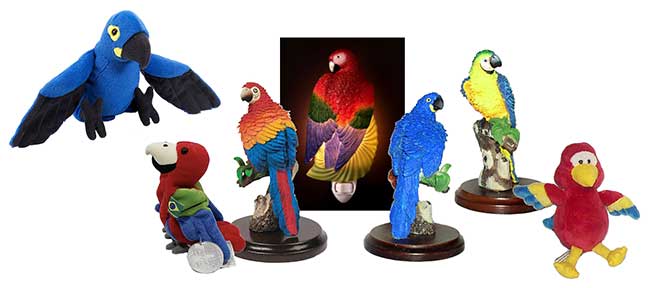
The macaw toys and gifts shown at top are available from our sponsor. We have macaw figurines, macaw night lights, macaw plush and Wild Republic Hyacinth Macaws. Find them at Jeannie's Cottage LLC.